September 13, 2009

Off-topic: Cookie Making/クッキー作り

Yesterday, my daughter wanted to make cookies. I reluctantly complied with her request. As you can see, we used the toaster oven to make cookies, as we usually do.
昨日、娘がクッキーを作りたいと言いました。嫌々、リクエストに答えました。ご覧の通り、クッキーを作るのに、いつも通り、オーブントースターを使いました。


September 4, 2009

Kuri Okowa (Glutinous Rice Cooked with Chestnuts)/栗おこわ

Two days ago, I got a box of chestnuts and other foodstuffs from my parents, who live in Chiba prefecture. That means that the fall is here again! What am I going to do with the chestnuts? Making kuri okowa, naturally! I love kuri okowa! To make kuri okowa, you must use glutinous rice, that is, mochi rice, not regular rice (uruchi mai in Japanese). That being said, I found that I didn't have enough mochi rice, so I also used some uruchi mai.
Thus, here is what I did:
2.5 go mochi rice
1.5 go regular rice
2.5 + 1.5 = 4 go
(1 go = 180 ml = 140 to 150 g in the case of rice)
In Japan, we usually use the metric system, but in the case of rice, we still use the unit of go.
30 large chestnuts, peeled
1 tbsp sake
1 tsp salt
Proper amount of water
I cannot specify the amount of water, because I use more chestnuts than most recipes call for.
You can peel chestnuts with a regular knife, but I use this special gadget, called Kurikuri Bozu. Even so, it took me more than half an hour to peel 30 chestnuts!
二日前、千葉県に住む両親から、栗や他の食べ物が入った段ボール箱が届きました。つまり、また秋が来たということです。この栗で何をするかって?もちろん、栗おこわを作ります!栗おこわは大好きです。栗おこわを作るには、普通のお米(うるち米)ではなく、もち米を使います。とは言うものの、もち米が足りなかったので、うるち米も使いました。
と言うわけで、こうしました:
もち米2.5合
うるち米1.5合
2.5 + 1.5 = 4合
(1合 = 180 ml = お米の場合は140~150 g)
日本では、メートル法を使いますが、お米の場合は、いまだに合という単位を使っています。
大きな栗30個、皮を剥く
お酒大さじ1
塩小さじ1
水適量
水の量は指定できません。レシピーに書いてある数より多くの栗を使うからです。
栗は普通の包丁でも剥けますが、私は「栗くり坊主」という特別な道具を使います。それでも栗を30個剥くのに30分以上かかりました!


August 11, 2009

Mirin/味醂(みりん)

Today, let me talk a little bit about mirin. I've wanted to talk about Japanese seasonings in some detail here, and I've wanted to start with mirin, because it is peculiar to Japanese cuisine.
In general, there are three types of mirin that are readily available in supermarkets in Japan: Hon mirin, hakko (jozo) chomiryo, and mirin-fu chomiryo.
今日は味醂(みりん)ついて少し話します。前から、日本の調味料について話したいと思っていましたが、みりんは日本料理独特のものなので、みりんから始めたいと思います。
一般的に、日本のスーパーですぐに手に入るみりんには3種類あります。本みりん、発酵(醸造)調味料、みりん風調味料です。


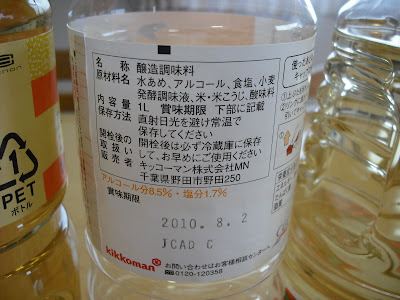


Left: Hon mirin
Raw materials: Mochi rice, rice, malt rice, jozo alcohol (distilled alcohol*), sugars
* Jozo alcohol is alcohol for brewing, but seems to be usually translated into distilled alcohol. Jozo alcohol is used in the process of making sake.
Alcohol content: 11.5 to 12.5%
Middle: Hakko (or jozo) chomiryo (fermented (or brewed) seasoning)
Raw ingredients: Mizuame (starch syrup), alcohol, salt, wheat fermented seasoning, rice/malt rice, acidic ingredients
Alcohol content: 8.5%
Salt content: 1.7%
Right: Mirin-fu chomiryo (mirin-like seasoning)
Raw materials: Mizuame (starch syrup), rice/malt rice brewed seasoning, brewed vinegar, acidic components
左: 本みりん
原材料: もち米、米、米こうじ、醸造アルコール*、糖類
*醸造アルコールとは醸造用アルコールのことですが、通常、distilled alcoholと訳されるようです。醸造アルコールは日本酒の製造過程で使われます。
アルコール分: 11.5度以上12.5度未満
中央: 発酵(醸造)調味料
原材料: 水あめ、アルコール、食塩、小麦発酵調味液、米・米こうじ、酸味料
アルコール分: 8.5%
塩分: 1.7%
右: みりん風調味料
原材料: 水あめ、米・米こうじの醸造調味料、醸造酢、酸味料

Of the three, only hon mirin is real mirin, while the other two are mirin-like products. Hon mirin is the most expensive, while mirin-fu chomiryo is the least expensive. Note that hakko chomiryo contains some salt to make it undrinkable (that is, to avoid liquor tax). You would hear people say, "Use hon mirin." I personally wouldn't say so. Reason? I can hardly tell the difference among the dishes made with them.
3つのうち、本みりんだけがみりんで、他の2つはみりんに似た製品です。本みりんが一番高価で、みりん風調味料が一番安価です。発酵調味料には、飲用できないよう(つまり、酒税を逃れるため)塩分が少し入っています。「本みりんを使え」と言う人が多いようですが、私自身はそうは思いません。理由は、どれを使って料理を作っても、その違いが殆ど分からないからです。

Anyway, hon mirin is said to have these six features:
1. Has a mild sweetness because it contains different types of sugars, such as glucose and oligosaccharide, whereas sugar has a strong sweetness because it is pure sucrose.
2. Gives the surface of the ingredients gloss and luster.
3. Keeps the ingredients from disintegrating, because of the sugars and alcohol contained in it.
4. Has deep body and umami due to the combination of the umami components, sugars, and other components produced from mochi rice.
5. The alcohol penetrates the ingredients quickly, making it easy for flavors to penetrate the ingredients.
6. Eliminates odor. The alcohol, which has penetrated the ingredients, takes the odor away when it evaporates. Also, it causes changes to odor components because of the reaction with sugars, amino acids, and organic acids.
ともかく、本みりんは次の6つの特徴があると言われています。
1.多種類の糖類を含んでいるので、柔らかい甘み。それに対して、砂糖はショ糖だけなので強い甘み。
2.具材の表面にテリとツヤをつける。
3.含まれる糖類やアルコールのため、具材の煮くずれを防ぐ。
4.もち米からできる旨み成分、糖類、その他の成分が組み合わさって、深いコクと旨みがある。
5.アルコールが具材にすぐ染み込み、具材に味が染み込みやすくする。
6.消臭。具材に染み込んだアルコールが蒸発する際に臭いを連れ出す。また、アルコール・糖類・アミノ酸・有機酸の反応で臭い成分に変化を起こす。
Reference/参考: Webpage of Zenkoku Mirin Kyokai/全国味醂協会のウェブページ (Japanese only)
(To be continued)/続く

August 8, 2009

Squid Simmered with Daikon/イカと大根の煮物

The other day, sashimi-grade surume ika (Japanese flying squids or Japanese common squids in English) were sold for 100 yen each, so I bought two. Natually, we had them (squid tubes) as sashimi.
先日、刺身用のスルメイカが一杯100円で売っていたので、2杯買いました。もちろん、胴体部分は刺身として食べました。

(By the way, don't expect me to decorate the sashimi with shredded daikon, green perilla, and so on!)
(ところで、私が細切り大根や青じそなどを飾るなどとは期待しないで下さい!)
I simmered the tentacles with daikon cut into quarters.
イカのゲソは銀杏切りにした大根と煮ました。

This time, I used a dashi, soy sauce, and mirin ratio of 12:1:1. Thus, I combined:
400 ml dashi
33 ml soy sauce
33 ml mirin
For this dish, you usually use squid tubes as well, and you usually parboil daikon before simmering with squid. I was in a rush, so I simply simmered squid tentacles first for a few minutes, then added daikon, and continued to simmer for another ten minutes.
今回は、出汁、しょう油、みりんの割合を12:1:1にしました。つまり、
出汁400 ml
しょう油33 ml
みりん33 ml
を合わせました。
この料理では、普通はイカの胴体も使い、また大根はイカと煮る前に下茹でします。私は急いでいたので、まずイカのゲソを数分煮て、大根を足し、さらに10分煮ました。
I must say that squid and daikon go very well together!
イカと大根はとてもよく合います!

August 3, 2009

What Has Become of My Shigefusa Nakiri/重房菜切りはどうなったか

Maybe you want to know that, and here is my answer: It still cuts as good as new although it has gotten a little rusty (due to lack of proper maintenance).
知りたい人もいるでしょう。答えは:まだ新品のようによく切れます。少しさび付いていますが(ちゃんとメンテナンスをしないせいで)。
This is where I store my Shigefusa, together with my other knives (except my Global santoku): Knife rack on the inside of the door of the storage space under the sink
重房は他の包丁(グローバルの三徳以外)と一緒にここに保管しています:シンクの下の収納スペースのドアの内側の包丁ラック。

As I said above, it has gotten a little rusty.
さっき言ったように、少し錆びています。

The tomatoes that I grow myself can have bruises such as this:
私が自分で育てているトマトにはこんな傷があることがあります。

I really like the way my Shigefusa nakiri goes right in where I want it to.
重房の菜切りは切りたいところにすっと入ってくれるところが好きです。


Ugly photo? Who else but me would like to take a photo of these and show it to you?
見苦しい写真?私以外誰がこんなものを写真に撮って、見せたがるでしょう?

August 1, 2009

As Much Watermelon as You Can Eat/スイカ食べ放題


Today, I went to the Yairo Suika Matsuri (Yairo Watermelon Festival), held on the premises of the Einou Center of JA Uonuma Minami from July 25 through August 10, together with my two children and a friend of my daughter's. There you can eat as much watermelon as you can for 500 yen per adult and 300 yen per elementary school student or under, and there is no time limit! What's more, the watermelons they serve are not ordinary ones but are called "Yairo Suika", which is known for its sweetness and "shari-shari" texture (sorry, I can't put it into English!).
The sad thing is that we were unable to eat as much as we thought we could eat.
今日は、JA魚沼ミナミの営農センターの敷地内で7月25日から8月10日まで行われている「八色西瓜祭り」に、子供2人と娘のお友達と行って来ました。そこでは大人500円、小学生以下300円でスイカを食べ放題でき、時間制限はありません!その上、出してくれるスイカは普通のではなく、甘さとシャリシャリとした食感で知られる「八色(やいろ)スイカ」と呼ばれるものです。
悲しかったことは、自分たちが思うほどは食べれなかったことです。

July 29, 2009

Maitake Pan-Fried with Butter/マイタケのバター焼き

I used the rest of the maitake to make "maitake no butter yaki" (maitake pan-fried with butter). I simply used butter and salt, and at the last minute, I added some soy sauce for flavoring. My children loved it!
残りのマイタケは「マイタケのバター焼き」を作るのに使いました。バターと塩だけを使い、最後にしょう油を風味付けに足しました。子供たちに気に入ってもらえました。

I also made "buta no shoga yaki" (pork pan-fried with ginger). I often make this dish, but this time, I made an experiment: using umeshu (Japanese plum liqueur) for cooking. So, I combined grated ginger with 30 ml soy sauce and 30 ml umeshu (instead of mirin). Only my daughter discerned the difference.
豚のしょうが焼きも作りました。よくこの料理を作りますが、今回は実験をしました。梅酒を料理に使うことです。そこで、すったショウガをしょう油30 mlと(みりんの代わりに)梅酒30 mlとあわせました。違いが分かったのは娘だけでした。


I had this soup, which I made for supper today, which contained sliced onion, okra, Malabar spinach, and Mulukhiyah.
私は、玉ねぎの薄切りとオクラとツルムラサキとモロヘイヤの入ったスープを飲みました。今日の昼食に作ったものです。