May 19, 2010

Nemagari Take Given from a Friend/お友達から頂いた根曲がり竹

I previously posted about nemagari take (lit. root-bending bamboo shoots) here in my blog. Here in the Uonuma district of Niigata prefecture, the nemagari take (lit. root-bending bamboo shoot) is the default bamboo shoot.
Today, I got these beautiful nemagari take from a friend.
ネマガリタケ(根曲がり竹)に関しては以前にブログのここに投稿しました。新潟の魚沼地方では、竹と言ったら、この根曲がり竹です。
今日は、お友達からこんなにきれいなネマガリタケをもらいました。

I'm sure you will have to pay more than 500 yen to get this amount of nemagari take from a local supermarket here!
これだけの量のネマガリタケなら地元のスーパーでは500円以上出さないと買えません!
I washed them, drained, and grilled in the toaster oven.
洗って、水を切って、オーブントースターで焼きました。


Ten minutes later, I took out two of them.
10分後、2本取り出しました。

to show you the inedible parts (skins) and the edible parts.
食べれない部分(皮)と食べられる部分を見せるためです。

Note that the right and left ends in the photo of the bamboo shoots are not edible.
ただし、写真の右と左の端も食べれません。

I grilled the rest for another five minutes or so.
残りはさらに5分程度焼きました。

As usual, I had them with ponzu and mayo.
いつも通り、ポン酢とマヨネーズで食べました。

Nemagari take are also good in miso soup and in nimono (simmered dishes).
ネマガリタケは味噌汁にも煮物に入れても美味しいです。

May 11, 2010

Miso Soup with Shrimp Heads/エビの頭の味噌汁

I previously mentioned miso soup with shrimp heads somewhere in my blog. Here is an additional description.
エビの頭の入った味噌汁については以前にも触れましたが、今回はもう少し記述を追加します。

First, a pack of ama ebi heads that I purchased yesterday for 50 yen:
まずは、昨日、50円で買った甘エビの頭1パック:

The shrimp come from Hokkaido.
このエビは北海道産です。

This amount of shrimp heads for only 50 yen. How can I not buy them??
たった50円でこれだけのエビの頭。買わずにはいられません!

Look at all those long feelers! They suggest that the shrimp are domestic ones not imported ones.
この長い触角(ひげ)を見て下さい!このエビが輸入品でなく国産である印です。

I currently use this white Echigo miso:
現在はこの越後白味噌を使っています。

Product name: Kuradashi Echigo Miso Shiro
製品名: 蔵出し越後みそ 白

Not so sweet as I imagined, and rather salty for shiro miso. I think I'll search for better Echigo shiro miso.
想像したより甘くなく、白味噌にしては塩辛いです。もっと良い越後白味噌を探そうと思います。

Very tasty!
とても美味しいです!


Notes:
1. Some recipes say to bake the heads in an oven or a toaster oven for several minutes to remove the odor before putting them into a pot of water. I skipped this step.
2. Most recipes call for no dashi because they say that you can get good dashi from the shrimp heads. I, for one, think that the dashi from the shrimp head is not strong enough and I usually add some instant dashi.
3. Some people simply leave the shrimp heads uneaten, and others (including my family) chew on them from the separated end to get what's inside. Some brave people eat them whole!
注:
1. レシピーによっては、鍋に頭を入れる前に、臭みを取るためオーブンやオーブントースターで頭を数分、焼くよう書いてありますが、私は省略しました。
2. 大抵のレシピーでは、エビの頭から良い出汁が出るので出汁は要らないと書いてありますが、私個人としては、エビの頭からの出汁はあまり強くないので、出汁の素を少し入れます。
3. えびの頭を食べずに残す人もいますし、(我が家のように)吸って中身を食べる人もいます。勇敢な人は丸ごと食べます!

May 9, 2010

Vegetable Gardening, Spring 2010/菜園作り、2010年春

Yesterday, my son and I spent the afternoon doing vegetable gardening.
昨日の午後は、息子と一緒に家庭菜園をしました。

Our rented farmland now looks like this.
私たちが借りている農地は今はこんな感じです。

We planted watermelon, cherry tomato, and tomato seedlings, among others.
スイカ、ミニトマト、トマトの苗などを植えました。

Edited to add: We also planted okra seeds, and will plant molokheiya seedlings as soon as they are available.
追加:オクラの種もまきました。モロヘイヤの苗も入手でき次第、植える予定です。

Farmland against Mt. Makitaha (near the center of the photo) and Mt. Kinjo(on the left).
農地。バックは巻機山(写真の中央近く)と金城山です。


In the yard around the house, we planted six tsurumurasaki (Malabar spinach).
家の周りの庭には、ツルムラサキを6本植えました。

Strawberry plants:
イチゴ:

Two sweet potato seedlings:
サツマイモの苗2本:

Piece of land where I planted corn seeds:
トウモロコシの種を植えた土地:

I forgot to place mulch before planting the seeds! So, I placed the mulch after I planted them. How stupid I was!
種をまく前にマルチを敷くのを忘れました。なので、種をまいてからマルチを敷きました。なんてバカなんでしょう!

Other strawberry plants:
他のイチゴ

The mulch was blown away by strong wind...
マルチは強風で飛ばされました...。

I bought two seedlings of tochiotome (strawberry variety) last year. They now look like this:
去年、とちおとめ(イチゴの品種)の苗を2本買いました。今ではこんな感じです。

Two perilla seedlings (top) and two basil seedlings:
シソ2本(上)とバジル2本:

Koshiabura/コシアブラ

Koshiabura (Acanthopanax sciadophylloides) is called the "sansai no joo" (queen of edible wild plants). My wife got a pack of koshiabura tempura from a relative, so I will post a photo of it.
コシアブラは「山菜の女王」と呼ばれます。妻が親戚からコシアブラの天ぷらをもらったので、写真を載せます。


"So, what is the "sansai no o" (king of edible wild plants)?", you might ask. Tara no me (fatsia sprout) is called the king of edible wild plants.
「じゃあ、「山菜の王」は何なの?」と言うかも知れませんが、タラの芽が山菜の王と呼ばれています。

Notes:
Image of tara no me
Images of koshiabura

Warabi Mochi-Like Puru Puru O-Mochi/わらびもち風ぷるぷるおモチ

Warabi mochi is very popular in Kansai (Western Japan), but in Kanto (Eastern Japan), it is much, much less popular. I, for one, had heard nothing of it when I lived in Tokyo. It was only after I joined eGullet that I learned about warabi mochi.
The following explains how to make mochi similar to warabi mochi. I don't know what warabi mochi purists will have to say about it, but as for me, I like it very much.
わらび餅は関西ではとても一般的ですが、関東ではあまり一般的ではありません。私自身は東京に住んでいる頃は聞いたことがありません。私がわらび餅のことを知ったのは、eGulletに入ってからです。
以下に紹介するのは、わらび餅に似たお餅の作り方です。わらび餅にこだわりのある人は何て思うか分かりませんが、私自身は大好きです。

This recipe is from the November 28, 2009 edition of the famous TV show, Sekai Ichi Uketai Jugyo (The Most Useful School in the World).
Access the website linked to above, scroll down, and click the "hand" with a long index finger in the second orange box to view the photos.
このレシピーは、2009年11月28日放送の、有名なテレビ番組「世界一受けたい授業」から知りました。
リンク先のサイトにアクセスし、スクロールダウンして、2番目のオレンジ色の枠内の、大きな人差し指の「手」をクリックすると、写真が見れます。

Ingredients:
300 ml (= 300 g) water
6 tbs (= 60 g) katakuriko (potato starch)
4 tbs (= 40 g) sugar

Directions:
Put all the ingredients in a pan, and mix well.
Heat over medium heat, constantly stirring, until transparent.
Immerse in iced water.
When chilled, tear into small pieces by hand.
Have them with kinako* and kuro mitsu (syrup made from kurozato (muscovado)).

*Kinako means roasted soybean flour, but we often use the term to mean a mixture of kinako and sugar (and a pinch of salt). Kinako is usually mixed with sugar at a ratio of 1:1. Adjust the ratio to your preferences.
材料:
水300 ml (= 300 g)
片栗粉大さじ6 (= 60 g)
砂糖大さじ4 (= 40 g)

作り方:
鍋に材料を入れ、よく混ぜる。
中火にかけ、かき混ぜながら、透明になるまで火を通す。
冷水に取る。
冷えたら、手で小さくちぎる。
きな粉と黒蜜で食べる。


I used a non-stick frying pan.
私はテフロン加工のフライパンを使いました。

I continued to heat over low heat for longer than necessary (for about 2 min.) to make sure that it was done.
私は、確実に火が通るよう、必要以上に長く(約2分)弱火で火を通しました。

Instead of putting in iced water, I put some kinako on a large plate, and transferred the mochi to the plate.
氷水に入れる代わりに、大きなお皿にきな粉を敷き、そこに餅を移しました。

Have it with a lot of kinako! (I didn't use kuromitsu.)
きな粉をたくさんつけて食べましょう!(私は黒蜜は使いませんでした。)


The recipe is quite similar to that of my milk mochi.
For my milk mochi, use
200 ml milk
2 tbs katakuriko
1 tbs sugar
As you can easily imagine from the ingredient ratio, my milk mochi is less chewy than the warabi mochi-like mochi shown above.
このレシピーは私のミルク餅iとよく似ています。
私のミルク餅には、
牛乳200 ml
片栗粉大さじ2
砂糖大さじ1
を使います。
材料の割合からすぐに想像できるように、私のミルク餅は、上記のわらび餅風おモチより柔らかめです。

May 5, 2010

Sashimi and Beer/刺身とビール

I am approaching my 50s, and I have recently felt that my taste in food has changed considerably. I don't crave meat as much as I did when I was in my 20s or 30s, and I often crave sashimi and beer for supper these days.
50歳代に近づいて、最近、食べ物の好みがかなり変わったと感じています。20代、30代の頃より肉は食べたいと思わず、最近は夕飯には刺身とビールを摂りたいと思います。

A pack of sashimi, a pack of carpaccio, and a pack of boiled edamame I bought today:
今日買った刺身1パック、カルパッチョ1パック、枝豆1パック:


Luckily, my wife got Masu no Sushi (Trout Sushi) from a relative.
嬉しいことに、妻は親戚から「ますの寿し」をもらってきました。

Masu no Sushi is a type of oshi zushi (lit. pressed sushi), and is a specialty of Toyama.
「ますの寿し」とは押し寿司の一種で、富山の名産です。

My wife cut it into eight pieces.
妻は8つに切りました。

May 4, 2010

Sansai Day for My Family/我が家族にとっては山菜の日

Today, I was planning to have a slow evening. I had told my wife that I would buy some sashimi and beer. But, sometimes, you will never know what your child (or children) will do to you, especially if your child is a nature-loving, mushroom-loving, and sansai-loving son.
First, at around 3 o'clock, my son came home with this:
今晩はゆったりと過ごそうと思ってました。妻には刺身とビールを買ってくると言っておきました。しかし、時には、子供が何をしでかすか分かりません。特に、その子供が自然を愛する、きのこを愛する、そして山菜を愛する息子の場合は。
まずは3時頃、息子はこれを持ってきました:

Udo (Aralia cordata). My son and I discussed what to do with them. Conclusions: Tempura for the leaves and kinpira for the stems.
ウドです。息子と私はどうしようか話し合いました。結論は:葉は天ぷらに、茎はキンピラに。

This means that I had to give up my initial plan to have a slow evening.
ということは、のんびり夜を過ごそうという当初の計画は諦めざるを得ませんでした。

Kinpira in the making:
キンピラを作成中:

Later seasoned with 40 ml soy sauce, 40 ml mirin, and 20 ml sake.
醤油40 ml、味醂40 ml、お酒20 mlで味付けしました。

He later came home with this:
後でこれを持って帰ってきました:

Chickweed. He said he wanted to have it boiled and have it as ohitashi.
はこべです。息子は、茹でて、おひたしとして食べたいと言いました。

He also brought me this:
またこれも持ってきました:

Young leaves of daylily. I know. He told me yesterday that he wanted to get some young leaves of daylily today. But I didn't expect that he would bring me other sansai.
カンゾウの若葉です。分かってます。昨日、カンゾウを今日取って来たいと言ってました。でも、他の山菜も持ってくるとは思いませんでした。

Besides, my wife came home with this:
その上、妻がこれを持って帰ってきました:

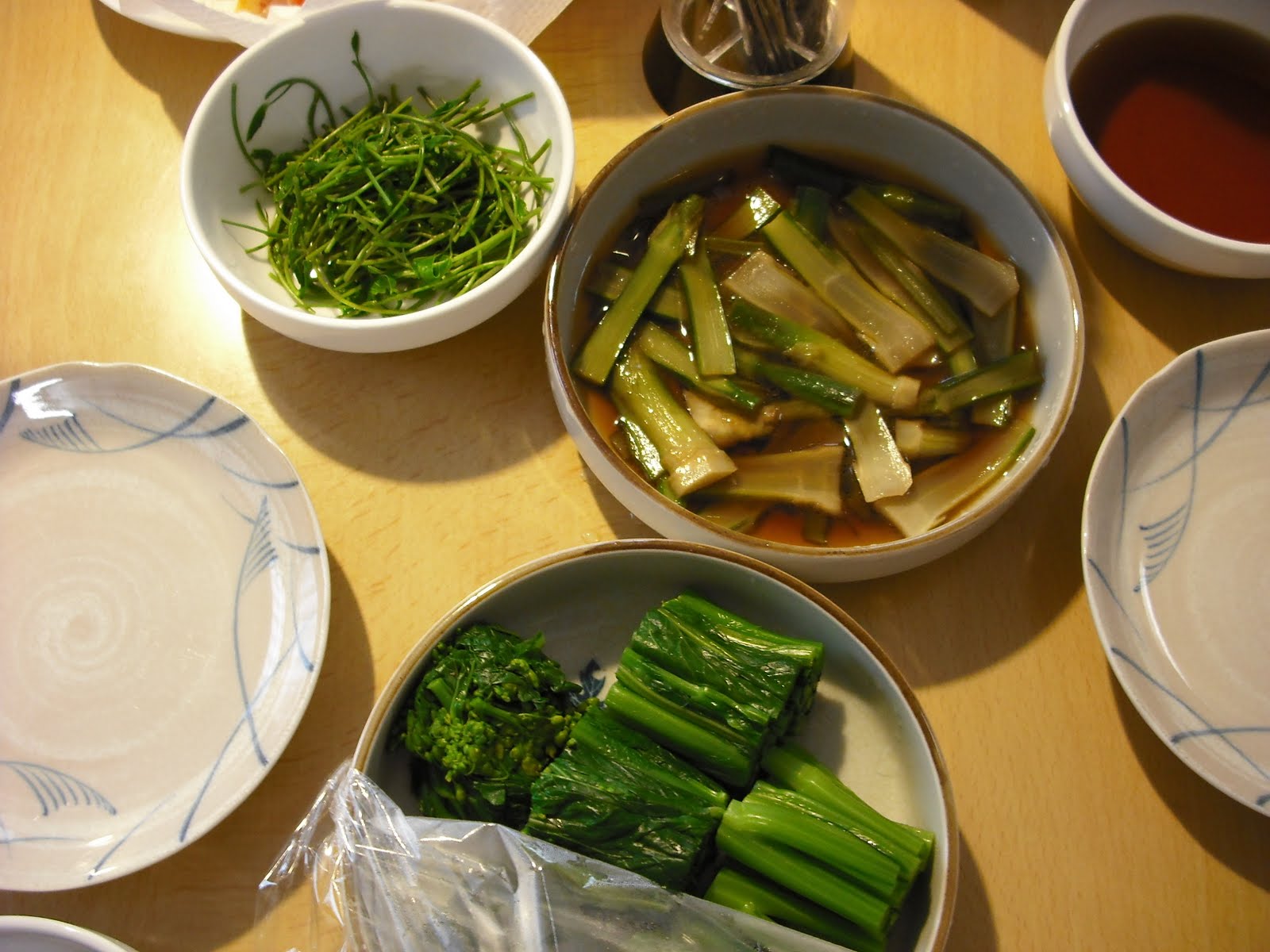
Leafy vegetable called "touna" (lit. winter green) here in the Uonuma district of Niigata. The photo shows only the half of what she got from her father.
新潟の魚沼地域では「冬菜」(とうな)と呼ばれる葉野菜です。写真に載っているのは、妻が実の父からもらった量の半分だけです。
I washed, drained, and boiled them all.
全部私が洗い、水を切り、ゆでました。

I stir-fried half the young leaves of daylily, together with some ham and eggs. I boiled the other half to have it as ohitashi.
カンゾウは若葉の半分は、ハムと卵と一緒に炒めました。残りの半分は茹でて、おひたしとして食べました。


Surprisingly, my son came home with yet another sansai:
驚いたことに、息子はまた別の山菜を持ってきました。

Young shoots of three-leaf akebia, called "kinome" here in the Uonuma district. ("Kinome" usually means young leaves of sansho.) Kinome are usually boiled and eaten as ohitashi.
三つ葉アケビの若芽です。魚沼地域では「木の芽」と呼ばれます。(通常、「木の芽」とは、山椒の若葉のことです。)木の芽は通常、茹でて、おひたしとして食べます。

Leaves of udo, ready to be tempura'ed:
天ぷらにする準備のできた、ウドの葉:


Boiled kinome, udo kinpira, and boiled touna:
茹でた木の芽、ウドのキンピラ、茹でた冬菜:


The dipping sauce for tempura was a 4:1:1 mixture of dashi, soy sauce, and mirin, as usual.
天つゆは、いつも通り、出汁、醤油、味醂を4:1:1で混ぜたものです。


I also made kakiage, with sakura ebi (dried small shrimp), onion, and carrot.
桜えび、玉ねぎ、ニンジンで、かき揚げも作りました。


When making tempura, be sure to use hakuriki ko (low-gluten flour), like these:
天ぷらを作る時は、このような薄力粉を使うようにして下さい。

And, use vegetable oil, like canola oil.
そして、菜種油(キャノーラ油)のような植物油を使って下さい。


I also made sweet potato tempura.
サツマイモの天ぷらも作りました。


I kept working in the kitchen from around 3:30 to almost 6:30! I will have sashimi and beer for supper tomorrow evening!
台所で3:30頃から6:30頃まで働き続けました。明日の夕飯には刺身を食べ、ビールを飲みます!