April 15, 2013

Nihonshu (Japanese Rice Wine) at Hitohada (Human Skin Temperature)/人肌の日本酒

One big characteristic of Japanese sake (nihonshu in Japanese) is that it can be drunk in a wide temperature range of about 5-55 oC.
Note: In Japanese, sake or o-sake (politer) is a generic term for any type of alcoholic beverage. To refer to Japanese rice wine, you need to use a more specific term like nihonshu (lit. Japanese sake) or seishu (lit. refined sake).
I personally like to have my sake (beer, shochu, and Japanese rice wine) well chilled. Recently, I found some sites that recommend having Japanese rice wine at hitohada (lit. human skin temperature), that is, around 35-37 oC. The reason for this is that the sweetness is at its peak at hitohada whereas the sourness remains the same regardless of the temperature, and nihonshu at hitohada has a good balance of sweetness and sourness.
So, I made a little expriment tonight. For this experiment, I used Takachiyo Honjozo from Takachiyo Shuzo, located in the Shiozawa area of Minami-Uonuma city.
日本酒の大きな特徴の一つは、約5~55度という幅広い温度範囲で飲めるという点です。
注: 日本語では、酒またはお酒(より丁寧)とは色々なアルコール飲料の総称です。Japanese rice wineを指すには、日本酒とか清酒とか、もっと特定の用語を使う必要があります。
私自身はお酒(ビール、焼酎、日本酒)をよく冷やすのが好きです。最近、人肌、つまり35~37度程度の日本酒を飲むことを勧めるサイトをいくつか見つけました。理由は、甘さは人肌で最高になる一方、酸度は温度に係わらず同じで、人肌の日本酒は甘さと酸度のバランスがいいからだそうです。
というわけで、今夜はちょっとした実験をしました。この実験には、南魚沼市の塩沢地域にある高千代酒造の高千代本醸造を使いました。
 
I raised the temperature of the sake, using the microwave oven.
電子レンジでお酒の温度を上げました。
Hm........, I still prefer my sake well chilled.
うーーん、やはりよく冷やしたお酒のほうが好きです。

April 14, 2013

Fukinoto and Yomogi Tempura/フキノトウとヨモギの天ぷら

Last night, my son said he wanted to have fukinoto tempura, so I decided to make fukinoto tempura, as well as yomogi (mugwort) tempura, for supper tonight, in place of my wife.
昨晩は、息子がフキノトウの天ぷらを食べたいと言うので、今日の夕飯には、妻の代わりに私がフキノトウの天ぷらやヨモギ(よもぎ、蓬)天ぷらを作ることにしました。
 
So, today, around noon, I went out to get some yomogi. Fortunately, my wife got a bag of fukinoko from her sister in the morning.
というわけで、今日、昼ごろ、ヨモギを取りに出かけました。運よく、フキノトウは午前中に妻がお姉さんからもらってありました。
 
My kobushi tree almost bloomed.
うちのコブシの木はもう花が咲きそうです。 

I went to the river bank, but unfortunately, I found NO moyogi there!
川岸に行きましたが、あいにく、ヨモギは全然ありませんでした!
Kanzo (daylilies) were too small to pick.
カンゾウはまだ小さくて採れませんでした。

Fukinoto (butterbur sprouts):
フキノトウ:
Young shoots of itadori (Japanese knotweed):
イタドリの若芽:
There was hardly any snow left in the snow dumping site.
雪の堆積場にはもう雪は殆ど残っていませんでした。
I remembered that I had some yomogi in my small yard.
うちの小さな庭にヨモギが少しあるのを思い出しました。

You can see both tsukushi and sugina in the photo below.
次の写真にはツクシ(土筆、つくし)とスギナ(杉菜、すぎな)が見えます。
Tsukushi and sugina are the same plant, horsetail. Because of the name, however, some Japanese seem to believe that sugina (sugi = cedar, na = greens) is related to cedar.
ツクシとスギナは同じ植物ですが、スギナ(杉菜)はその名前のせいで、日本人の中には、杉と関係あると思っている人がいるようです。

Luckily, I found these yomogi in my yard.
運よく、うちの庭にヨモギがありました。
Before three thirty, I finished preparing the ingredients for tempura.
3時半までに、天ぷらの具の下準備が終わりました。


Close-up:
クローズアップ:

At five in the evening, I started to make tempura. I didn't use all the fukinoto or yomogi. Because I'm on a diet, I just can't continue to eat leaftover tempura for lunch for days.
夕方5時に、天ぷらを作り始めました。フキノトウとヨモギは全部使いませんでした。ダイエット中なので、何日も昼食に残りの天ぷらを食べ続けたくないので。
I boiled the two packets (2 x 300 g) of inaka (lit. country) soba (buckwheat noodles) that I recently bouth at the 100-yen shop. Shown in the photo is about half the soba I boiled.
最近100円ショップで買った田舎そばを2パック(2 x 300 g)茹でました。 写真に写っているのは茹でたそばの約半分です。
The soba was much better than I had anticipated.
そばは思ったよりずっと美味しかったです。

Fukinoto tempura is bitter, and you can have two or three pieces only. Like I said previously, I think that yomogi tempura is much better than shiso (perilla) tempura.
フキノトウの天ぷらは苦いので、二つか三つしか食べれません。前にも言いましたが、ヨモギの天ぷらはシソの天ぷらよりずっと美味しいと思います。

April 12, 2013

Fuki/蕗(ふき、フキ)

Today, I got a box of natsumikan from my father. He said these were really the final ones. In the box, I found a plastic bag of fuki stalks, and I called him to ask how to prepare them. He assured me that it wouldn't be necessary to peel them because they were small. I was relieved to hear that because peeling is the most tediuous part of fuki preparation.
今日は父から夏みかんを1箱もらいました。これで本当に最後だそうです。箱の中にはフキが1袋入っていたので、父に電話して、下ごしらえの仕方を教わりました。小さいので、皮をむく必要はないと言ってくれました。皮をむくのがフキの下ごしらえで一番退屈なことなので、それを聞いて安心しました。
A common way is to first place fuki on a cooking board, sprinkle some salt, and roll them. This technique is called ita zuri.
一般的な方法では、まずフキをまな板に載せ、塩を振りかけて、転がします。板ずりといいます。  
Put plenty of water in a large pot, and bring to a boil. Add fuki, and parboil for 3-5 minutes depending on the thickness.
大きな鍋に水をたっぷり入れ、沸騰させ、フキを加え、太さに応じて3~5分茹でます。
Cool in cold water, and drain.
冷水で冷やし、水を切ります。
Then, you have to peel the skin from each fuki. This is the most tediuous part, as I said above.
次に、フキそれぞれから皮をむきます。上記のとおり、一番退屈な部分です。

Of course, I omitted this step. I made kinpira with just a small portion of fuki.
もちろん、私はここは省きました。フキをちょっとだけ使ってきんぴらを作りました。
 
Like I mentioned several times in my blog, fuki should not be confused with fukinoto. Wikipedia does not clearly distinguish fuki (leaf stalk of fuki) from fukinoto.
The book, Japanese Cooking: A Simple Art, explains fuki as follows:
このブログで何度も言っているように、フキをフキノトウ(蕗の薹、ふきのとう)と混同しないでください。Wikipediaでもフキ(フキの葉柄(ようへい)とフキノトウをはっきり区別していません。
Japanese Cooking: A Simple Artという本ではフキを次のように説明しています。


But no mention of fukinoto.
フキノトウについて言及はないです。

Previous post on kyarabuki
Previous post on fukinoto
きゃらぶきに関する過去の記事
フキノトウに関する過去の記事

April 11, 2013

My Purchases at the 100-Yen Shop Today/今日100円ショップで買ったもの

Today, I took the morning off, and went to the 100-yen shop nearby. But first, I went to the supermarket a little after nine o'clock to get daikon for 98 yen each, among others.
今日は午前中は仕事を休み、近くの100円ショップに行きました。その前に、9時ちょっと過ぎにスーパーに行って、一本98円の大根などを買いました。
I sprinkled 1 tsp salt on the greens, and rubbed well.
塩を葉っぱに振り掛け、よくもみました。
Then, I made three grooves in my nukadoko.
次にぬか床(どこ)に溝を3本作りました。
I put the greens in the grooves, and
溝に葉っぱを入れ、
buried the greens.
葉っぱを埋めました。
I hope I can get tasty daikon greens nukazuke tomorrow.
明日には美味しい大根の葉っぱのぬか漬けができると思います。

I also simmered some natsumikan peels. Then I headed for the 100-yen shop.
夏みかんの皮も煮ました。それから、100円ショップに向かいました。

Here are the items I bought:
Top: Myoga (Japanese ginger) roots
Bottom left: Asparagus roots
Bottom right: Fukinoto roots
私が買ったものです:
上: みょうが(茗荷)の根
左下: アスパラガスの根
右下: ふきのとう(蕗の薹、フキノトウ)の根

Inaka (lit. country) soba and containers of two different sizes:
田舎そばと2種類の容器:
Seeds:
Top: Okura, two varieties of shiso
Bottom: Mitsuba, chuu dama (medium-size) tomato, and mulukhiya
種:
上: オクラ、シソ2品種
下: みつば、中玉トマト、モロヘイヤ 
(They cost 105 yen per 2 bags.)
(2袋で105円でした。)
Why did I have to go to the 100-yen shop? To get this COLOR BOARD.
なぜ100円ショップに行ったかと言うと、このカラーボードを買うためです。
I needed the board to fix the hole my son made last year while playing with his soccer ball.
ボードは息子が去年サッカーボールで遊んでいる時に作った穴を直すのに必要でした。
I managed to fix it.
どうにか直せました。 
Do you believe that my son broke this side-view mirror AND made this hole with a single kick of his soccer ball?
息子はサッカーボールを一回蹴っただけで、サイドミラーを壊し、この穴を開けたって信じられますか?
Natsumikan peels, now soaked in water.
夏みかんの皮は水に漬けました。
My lunch today:
Store-bought mini menchi (top) and regular-size beef korokke, which my wife bought last Monday.
Leftover shredded cabbage
Less rice than usual
今日の昼ごはん:
月曜に妻が買った市販のミニメンチ(上)と普通サイズのビーフコロッケ
残りのキャベツの千切り
普段より少ないごはん  
I'm still on a diet. I have decided to lose another five kg. I still have a long way to go!
まだダイエット中です。あと5 kg減量することにしました。まだまだ先は長いです!

Yesterday, my wife got a bag of fukinoto from her sister. My wife fried them with miso. So, it's a type of miso itame.
昨日、妻はお姉さんからフキノトウを1袋もらいました。味噌で炒めました。ですので、これは味噌炒めの一種です。
Images of Miso itame/味噌炒めのイメージ

April 5, 2013

Bo Dara Ni/棒だら煮

bo = bar, rod, stick
dara < tara = cod
ni < niru = to simmer
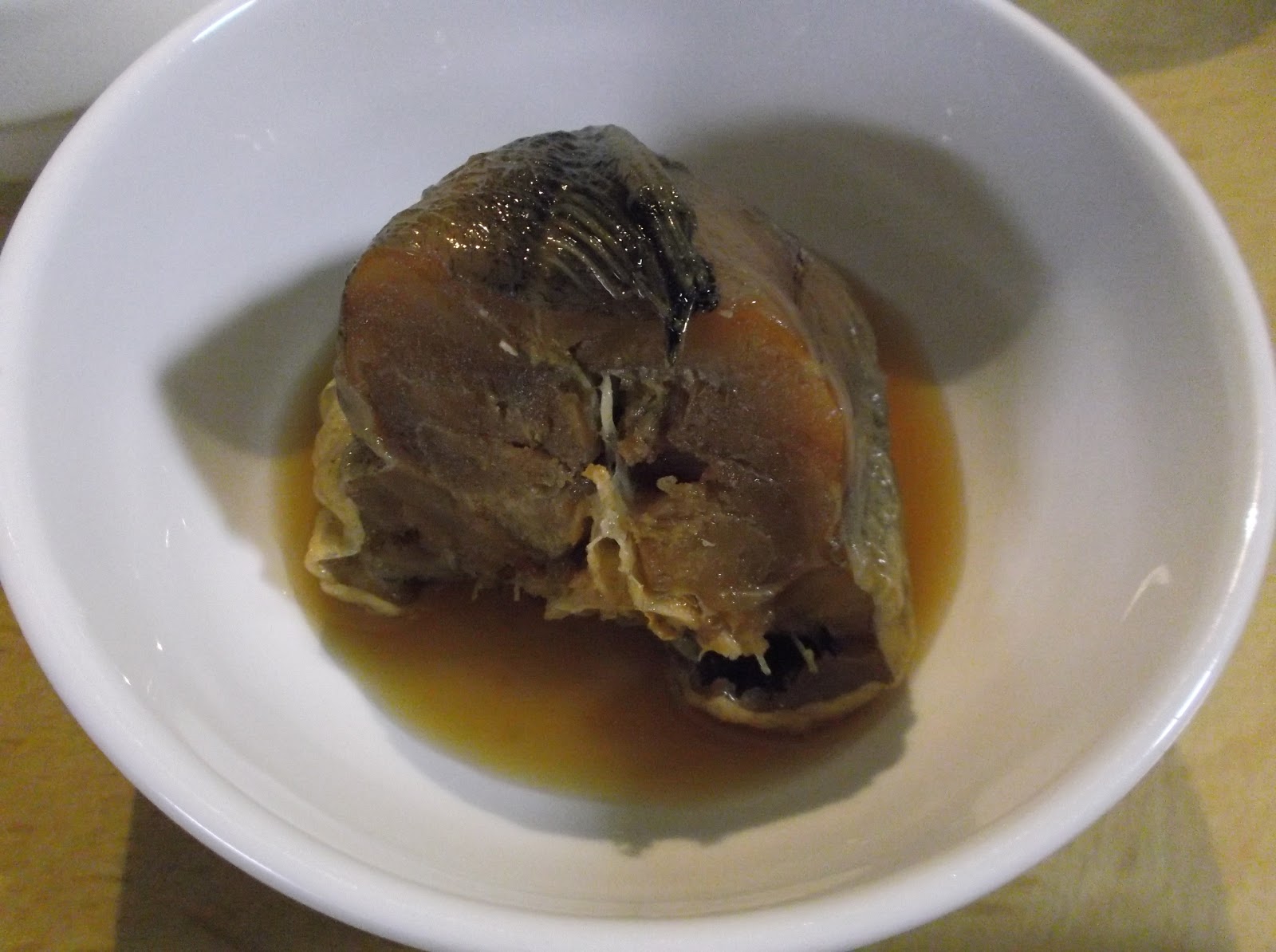
Bo dara ni is a very popular dish in Niigata and other prefectures.
 
Bo dara is dried cod, and is so called because it's like a bar.
Results of Google image search for bo dara.
Shown below is a cheaper, pre-cut vesion:
棒 = bar, rod, stick
だら < たら = cod
煮 < 煮る = to simmer
棒だら煮は新潟県などでとても一般的な料理です。
 
棒だらとは、干した鱈(たら、タラ)のことで、棒のようなので、棒だらと言います。
棒だらのGoogleイメージ検索の結果。
写真のは、安い、切ってあるタイプです:

I got this bag of 400 g bo dara for about 700 yen yesterday.
昨日、1袋(棒だら400 g)を700円程度で買いました。
First, I soaked 200 g bo dara in cold water for 2-3 hours, with a single change of water. The instructions supplied with the bo dara say to soak it for about 30 minutes, with a single change of water. The soaking time varies greatly.  One recipe I found says to soak it for as long as one week, with several changes of water.
まず、棒だら200 gを冷水に2~3時間漬けました。途中、水を一回替えました。棒だらについてきた説明書では、一回水を替え、30分くらい漬けると書いてあります。漬ける時間は大きく異なります。私が見つけた或るレシピでは、水を数回替えながら、1週間も漬けると書いてありました。
Soaked for 2-3 hours.
2~3時間漬けた後。
Fully reconstituted.
完全に元に戻りました。
I basically followed this recipe:
基本的にこのレシピを使いました。
Ingredients for 4 servings:

100 g bo dara

50 g sugar
2 tbsp sake
4 tbsp soy sauce
2 tbsp mirin
1 tbsp vinegar
4人分の材料:

棒だら 100 g

砂糖 50 g
酒 大さじ2
しょう油 大さじ4
みりん 大さじ2
酢 大さじ1

Directions:
1. Put reconstituted bo dara in a pot, and add plenty of water. Bring to a boil on high heat. When it comes to a boil, turn to medium heat, and simmer until the bones become soft (2-3 hours).
2 Add seasonings, and boil down on low heat.
Edited to add:
The recipe does not specify the amount of water to put in the pot. I added water to fully cover the cod.
I reduced the amount of sugar by half.
作り方:
1. 戻した棒だらを鍋に入れ、水をたっぷり入れ、強火で沸騰させる。沸騰したら、中火にして、骨が柔らかくなるまで(2~3時間)煮る。
2 調味料を入れ、弱火で煮詰める。
追記:
レシピには鍋に入れる水の量が書かれてません。私は棒だらが完全にかぶるくらい水を入れました。
私は砂糖の量を半分にしました。

Despite the directions, I simmered the bo dara for a total of 1 hour or so. So, the bones were still rather tough, and the liquid was not boiled down sufficiently.
作り方に反して、私は全部で1時間くらいしか煮ませんでした。骨はまだ固めで、汁も十分に煮詰まっていません。
Anyway, I liked my bo dara ni. My wife, who has been familiar to this dish since childhoood, said it was good.
とにかく、自分で作った棒だら煮は気に入りました。小さい頃からこの料理に慣れ親しんでる妻も、おいしいと言ってくれました。
I think I'll use the rest of the bo dara in a different way.
残りの棒だらは違った風に使おうと思います。

April 1, 2013

Anbo/あんぼ

Anbo are very popular in the Uonuma region of Niigata prefecture. They are somewhat similar to oyaki (or yakimochi) in Nagano prefecture, but when you taste them, you will see they are quite different in flavor and texture. These particular ones were given to us by my wife's father.
あんぼは新潟県の魚沼地方ではとても一般的なものです。ちょっと長野県の「おやき」(やきもち)と似ていますが、食べてみれば、味や食感はかなり違うと分かります。写真のは、妻の父からもらったものです。

They weren't grilled yet, so I grilled them in the toaster oven.
まだ焼いてないので、オーブントースターで焼きました。 

Daikon leaves stir-fried with miso are a very common filling.
味噌で炒めた大根がとっても一般的な中身です。
I'm thinking of making anbo myself, but in the meantime, check out this video (Japanese only) to get a general idea of how to make them.
自分であんぼを作ろうと思っています。それまでは、このビデオを見れば作り方の概略がわかると思います。