Showing posts with label Vegetable gardening. Show all posts

June 26, 2017

Cultivating Buckwheat/そばの収穫

On April 21, my father sowed 1 kg of buckwheat seeds on a plot measuring 23 m x  8 m. On May 7, I helped my father put up a net over the plot as I described here. On June 24, when the "blackening ratio" of the buckwheat seeds reached 70-80%, my father and I cultivated the buckwheat.
4/21、父は23 m x 8 mの土地に蕎麦の種を撒きました。ここで述べたように、5/7、その土地にネットを張るのを手伝いました。6/24、そばの種の黒化率が70~80%になったので、父と二人で蕎麦を収穫しました。


I'm not quite sure, but my father says 80% of the buckwheat seeds are now black.
私自身ははっきり分かりませんが、父が言うには、そばの種の8割が黒くなっているそうです。
I did almost all the cropping manually with a sickle, while my father bundled the stems.
刈り取りは殆どすべて私が鎌を使って人力で行い、父が束にしました。
We put the bundles in the light truck (called "kei tora" for short), and carried them to the overhead grapevine trellis with a roof in front of the house.
軽トラック(軽トラ)に束を載せ、家の前の、屋根のあるぶどう棚まで運びました。
They are now hung to dry.
吊るして干しています。
It will take one week or so for them to dry. My father hopes to get 20 kg of buckwheat from the bundles.
乾くのに1週間ほどかかります。この束から蕎麦が20 kgくらい取れればいいなあと、父は言ってます。
 
Edited to add:
追記:
 
Due to the bad weather, the drying process is quite slow.
天気が悪くて、乾燥は遅れています。
 
I talked about the "blackening ratio". Cropping buckwheat when the blacking ratio is 70-80% is recommended because the seeds that are still white will turn black in the drying process. If you crop buckwheat when the ratio is almost 100%, you will lose a considerable amount of seeds while cropping.
「黒化率」について話しましたが、黒化率が70~80%の時に蕎麦を刈るのがいいです。まだ白かった種は乾燥過程で黒くなります。黒化率が100%に近い時に刈ると、刈っている最中にかなりの量の種が失われます。 


October 14, 2016

Harvesting Sweet Potatoes/サツマイモの収穫

Today, I finally got around to harvesting the sweet potatoes from my rented field.
今日はやっと借りている畑からサツマイモを収穫することができました。

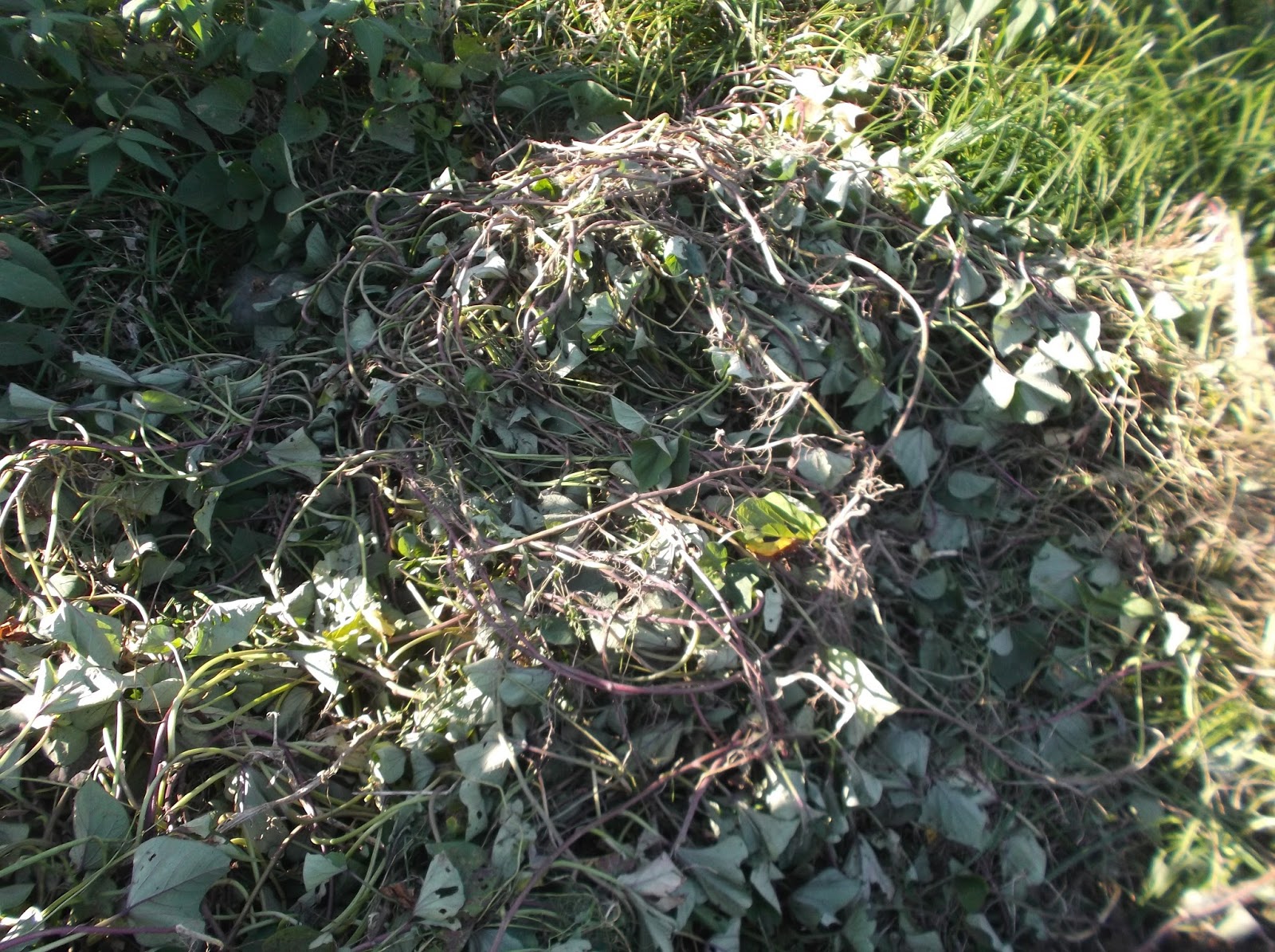
The susuki (Japanese pampas grass) had grown so tall that I could hardly see my rented field.
ススキが伸びていて、借りている畑がほとんど見えませんでした。
Sunny, warm day perfect for any outdoor activity including harvesting!
晴れた、暖かい一日で、収穫など外作業に最適でした。
You could never guess what was growing... I had planted sweet potato seedlings in two of the four rows in the field. I had planted seed potatoes in the other two, and I harvested the potatoes this summer. I have left the field almost unattended since then.
何が育っているのか分からないと思います。畑の4つの畝のうち2つにサツマイモの苗を植えてあります。残りの2つの畝にはジャガイモの種イモを植え、夏に収穫しました。その後、畑はほとんど何もしていません。
Two hours later, I was able to harvest all the sweet potatoes, plus three kobocha and some potatoes!
2時間後、サツマイモをすべてと、カボチャを3個、ジャガイモが少し収穫できました。

Sweet potatoes in two 45-liter plastic bags.
45リットルの袋に入れたサツマイモ
I placed them all in the garage to dry. You can see some potatoes in the lower right of the photo.
全部、ガレージに置いて、乾かしました。写真の右下にジャガイモが見えます。

July 28, 2016

Harvesting New Potatoes/新じゃがの収穫

I have already talked about shin jaga (new potatoes) here, so I will be brief.
新じゃがについてはここですでに述べているので、簡潔にします。

At around noon yesterday, I went to my rented field just to see how the potatoes and the sweet potatoes were growing. When it comes to vegetable growing, I'm one of the laziest, vising my field only once a week, and I can leave it unattended for almost two weeks when I'm busy with work.
昨日の昼頃、じゃがいも(ジャガイモ、馬鈴薯(「ばれいしょ」とも)とさつまいも(サツマイモ、薩摩芋)の育ち具合を見に、借りている畑に行きました。野菜作りに関しては、私はとてもルーズで、一週間に一回くらいしか見に行かないし、仕事が忙しい時は2週間近くもほっておくことがあります。
I was surprised to see that some potatoes were visible. Some leaves were turning yellow. It was obvious that I had to harvest the potatoes.
じゃがいもがいくつか見えているので驚きました。葉も黄色くなってきており、もうじゃがいもを収穫すべきなのは明らかでした。
Before:
ビフォー: 
After:
アフター: 

I got this amount of potatoes from 3-kg seed potatoes!
種芋3キロからじゃがいもがこれだけ採れました! 
I'm going to make hash browns and potato salad.
ハッシュポテトとポテトサラダを作るつもりです。 

October 29, 2015

Sweet Potatoes/サツマイモ

Just a memo for myself.
ただの備忘録です。

March 12
3/12
Snow dumping site on the bed of the Uono River.
Photo taken on the day of Nogu Ichi (Farm Tool Market) here in the Minami-Uonuma region. The day on which the winter is supposed to end here in this snowy region.
魚野川の河川敷にある雪堆積場。
南魚沼地域の農具市の日に撮った写真。ここ雪国で冬が終わると言われている日です。

May 4
5/4
Snow dumping site. The snow is completely gone. Here in this snowy region, farming usually starts in May.
雪堆積場。雪は完全に消えています。ここ雪国では、農業は通常、5月に始まります。

My rented field at the center of the photo.
写真の中央に、私が借りている畑。
I'm a minimalist in many ways, so I just took with me these two tools (hoe and sickle), a pair of gloves, a PET bottle of water (to quench my thirst, naturally), a bag of organic limes, and another bag of chemical fertilizers. Each bag contains just enough amount for the size of the field.
私は色んな面でミニマリスト(必要最低限の物しか持たない)ので、持って行ったのは、道具2つ(鍬と鎌)、手袋、水の入ったPETボトル(もちろん、のどの渇きを抑えるため)、有機石灰の入った袋、化学肥料の入った袋だけです。それぞれの袋には、畑の大きさにちょうど合った量だけ入れました。

Forgot to mention that I had previously carried several bags of cattle manure to the field.
牛ふん堆肥は数袋、すでに畑に運んでおきました。

Done!
完了!
It took me 2-3 hours for this work, if I remember correctly.
記憶が確かなら、この作業に2~3時間かかりました。
May 6
5/6
Road to the field.
畑までの道。
Lots and lots of kogomi (ostrich fern) on the river bed,
河川敷には、こごみがいっぱいありますが、

overgrown and not good to eat.
大きくなり過ぎで、食べれません。
Sweet potato seedlings.
サツマイモの苗です。
I planted them in two rows in a single une (ridge).
一つの畝(うね)に二列に植えました。
I planted other seedlings (kabocha, potato, and cherry tomato) in the field.
畑には、他の苗(かぼちゃ、じゃがいも、ミニトマト)も植えました。
Note that the light truck in the photo above is not mine. I walk or bike to the field.
上の写真の軽トラは私のではありません。私は畑に行く時は歩きか自転車です。

October 27
10/27
I forgot to take decent photos before I dug out the sweet potatoes.
Photo taken after I dug out the sweet potatoes.
サツマイモを掘り出す前に、ちゃんとした写真を撮るのを忘れました。
サツマイモを掘った後に撮った写真。
I have already decided not to grow any vegetables this fall.
今年の秋は、野菜は何も作らないことに既に決めています。
I got these sweet potatoes, and
サツマイモはこれだけ採れました。

some potatoes.
ジャガイモも少し。


November 21, 2014

Pickled Radish/二十日大根の漬物

Sunny and warm days like this are very precious around this time of year in my snowy area. High mountains are already capped with snow. The snow-capped mountain at the center in the photo below is Mt. Hakkaisan. Hakkaisan (lit. Eight-Sea Mountain) is also the name of a famous sake brand of the sake brewery located near the mountain.
私の住む雪国では、一年のうちの今頃は、今日のような晴れで暖かい日はとても貴重です。高い山々はすでに雪をかぶっています。次の写真の真ん中にある雪をかぶった山は八海山(はっかいさん)です。八海山とは、この山の近くにある酒蔵の有名な酒の銘柄でもあります。
Mt. Kinjo (center left) and Mt. Makihata (center right) are also capped with snow.
金城山(きんじょうさん、中央左)と巻機山(まきはたやま、中央右)も雪をかぶっています。
My rented field:
借りている畑:
I got the second and last crop of radishes from the field.
畑から二度目で最後の二十日大根を収穫しました。

I pickled the second crop just like I did with the first. The container on the left contains the liquid (100 ml vinegar + 100 ml mirin-style seasoning + 1 tsp salt) used to pickle the first harvest. (I usually reuse the liquid three times.)
最初の収穫と同じように、二度目の収穫も漬物にしました。左側の容器には、最初の収穫を漬けた液(お酢100 ml + みりん風調味料100 ml + 塩小さじ1)が入っています(私は液は通常、3回再利用します)。
I added the radishes to the container, and added some additional vinegar, 1 tbsp sugar (instead of mirin), and some salt.
二十日大根を容器に入れ、お酢少しと砂糖を大さじ1(みりんの代わり)、塩を少し足しました。
Should be pickled in half a day or overnight.
半日または一晩で漬かるはずです。

October 6, 2014

Vegetable Gardening, Fall of 2014/菜園作り、2014年秋

For the past few weeks, I have done a great deal of learning about vegetable gardening, reading tens of related books, mooks (magazine+books), and websites, in an attempt to improve my gardening skills.
ここ数週間、菜園技術を改善しようと、 関連する本、ムック、サイトを読んで、菜園作りについて多くのことを学びました。

Improvement 1: Measure out the compost, lime, and fertilizer accurately.
Here are the chemical fertilizer and the organic lime that I use.
改善1: 堆肥、石灰、肥料を正確に量る。
私が使っている化学肥料と有機石灰です。 
For compost, I use either bark compost or cattle compost. Shown below is cattle compost.
堆肥は、バーク堆肥か牛ふん堆肥を使っています。下のは牛ふん堆肥です。  
I have decided to use, in general, the following amounts per square meter:
30 g fertilizer
100 g lime (for spinach, 150 g)
3 liters compost
一般的に、1平米当たり、下記の量を使うことにしました:
肥料 30 g
石灰 100 g(ホウレンソウの場合は150 g)
堆肥 3リットル
Improvement 2: Use compost, lime, and fertilizer efficiently.
Improvement 3: Divide the rented field into six sections, each measuring 1 x 3 m.
改善2: 堆肥、石灰、肥料を効率的に使う。
改善3: 借りている畑を6区画に分ける(1区画1 x 3 m)。

My rented field on October 4:
借りている畑、10/4:
First, I removed all vegetable plants, as well as most of the weed, from the soil, and I tilled the rows separately. Then I divided each row into two sections by making a path in the middle.
まずは野菜全部と、雑草の大半を土から抜いて、畝を別々に耕しました。次に、畝それぞれを、真ん中に通路を作って、2区画に分けました。
Then, I sprinkled the measured amounts of compost, lime, and fertilizer on each section.
そして、堆肥、石灰、肥料を量って、各区画に撒きました。
Finally, I tilled each section.
最後に、各区画を耕しました。
You may think I'm a fool, but I used to till the entire field, sprinkled compost, lime, and fertilizer without measuring them on the entire field. Then, I made rows. What a waste!

I think dividing the field into smaller sections will make everything more manageable.
バカだと思うかも知れませんが、畑全体を耕し、堆肥、石灰、肥料を測らずに畑全体に撒き、それから畝を作っていました。すごい無駄でした!

畑を小さい区画に分ければ、全てがより管理しやすくなると思います。

I decided to plant these seedlings the next day.
この苗は次の日に植えることにしました。
Fava bean, snow pea, and snap pea seedlings, which I made myself.
自分で作った、ソラマメ、サヤエンドウ、スナップエンドウの苗です。

Yard around the house
家のまわりの庭

Area 1, before:
エリア1、ビフォー:
Area 2, before:
エリア2、ビフォー:
Area 3, before:
エリア3、ビフォー:
Area 1, under treatment:
エリア1、処理中:
Area 2, under treatment:
エリア2、処理中:
Area 3, under treatment:
エリア3、処理中:
Area 1, after:
エリア1、アフター:
Area 2, after:
エリア2、アフター:
Area 3, after:
エリア3、アフター
I planted these seeds in the areas.
各エリアにはこの種を植えました。
Komatsuna in area 1, spinach in area 2, and ohsakina in area 3.
エリア1にはコマツナ、エリア2にはホウレンソウ、エリア3には大崎菜。
October 5
10/5
I planted all the seedlings, as well as spinach, ohsakina, and radish seeds. One section is reserved for strawberry seedlings.
苗全部と、ホウレンソウ、大崎菜、はつか大根の種を植えました。一つの区画はイチゴの苗用に取ってあります。

Improvement 4: Make compost from kitchen garbage, using buckets.
改善4: バケツを使って、生ごみから堆肥を作る。

Improvement 5: Refrain from using mulch.
This I have learned from natural farming. You just have to cut off weed occasionally with a sickle and lay it like mulch. At this point, I'm not sure if this works for me. I may return to mulching.
改善5: マルチの使用を控える。
自然農法から学んだことです。時折、雑草を鎌で刈って、マルチのように敷く必要があります。現時点では、効果があるか分かりません。マルチに戻るかも知れません。

Another great thing I have learned from one book is that you don't necessarily have to practice crop rotation. You can practice continuous cropping simply by taking appropriate measures like soil improvement and companion planting. I don't like crop rotation because I don't want to grow vegetables I don't want to grow just for the sake of crop rotation. I just want to keep growing vegetables I want to grow in every season. Next year, I will plant some cherry tomato seedlings with nira (Chinese chive) seedlings and others with edamame seedlings to test to see if companion planting will really work for me.
或る本から学んだすごいことは、必ずしも輪作(りんさく)をしなくてもいいということです。土壌改良や混植など適切な対策をすれば、連作をすることができます。私は、輪作のために作りたくない野菜を作るのは嫌いです。毎シーズン、作りたい野菜を作り続けたいと思っています。来年は、ミニトマトの苗の一部をニラの苗と一緒に、残りはエダマメの苗と一緒に植えて、混植が本当に効果あるか試したいと思います。