November 18, 2012

Making Hoshi Gaki (Dried Persimmons)/干し柿作り

Last Friday, I got a box of shibu gaki (astringent persimmons) from my father.  I checked them all and found 27 of them were without T-shaped twigs.  I decided to remove the astringency from them ("sawasu" in Japanese) with alcohol.
金曜日に父から渋柿を一箱もらいました。全部調べてみると、27個はT形の小枝がついていませんでした。その柿はアルコールで渋を抜く(「さわす」ことにしました。
In general, a spirit with an alcohol content of 35% or greater is used for this purpose.  A special spirit specifically for this purpose has an alcohol content of 47%!  I decided to try my shochu with  25% alcohol.
一般的に、渋抜きにはアルコール度数35%以上のお酒を使います。渋抜き専用のお酒は、アルコール度数が47%もあります。私は度数25%の焼酎を試すことにしました。 
Just dip the upper part of each persimmon in a container of shochu.
下記の上の部分を焼酎の入った容器に漬けるだけです。
This is a common step, and I followed it, wondering if it would be possible just to put all the permissions in a plastic bag and sprinkle some shochu over them.
それが一般的な方法なので、それに従いましたが、単に柿を全部ビニール袋に入れて、焼酎をその上にかけてもいいのではないかと思いました。

Put all the persimmons in a plastic bag, and seal the bag tight.
柿を全部ビニール袋に入れ、袋をきっちり閉じます。
Because of the less alcohol content, it may take a little more time to remove the astringency.  Ten days maybe?
アルコール度数が低いので、渋が抜けるのに時間がかかるかも知れません。10日間くらい?

My wife suggested that I remove the astringency from all the persimmons this way, but I protested.  I finally decided to remove the astringency from 20 more and dry the remaining 14.
妻は、柿を全部この方法で渋抜きしたほうがいいと言いましたが、私は反対しました。結局、さらに20個を渋抜きして、残りの14個を干すことにしました。
I dried them in the garage.
車庫に干しました。
While peeling, one persimmon lost its T-shaped twig, and I had to consider how to hang it.
皮を剥いている時に、柿が一つ、T形の枝がなくなってしまいました。どうやって吊るか考えました。
It will take one month to dry them completely.
完全に干すのに一ヶ月かかります。

November 16, 2012

Using a Whole Daikon for Supper/夕飯に大根一本を使う

Do you know how to use a daikon for cooking properly? It is generally said that the upper part of a daikon is sweet and good to eat raw, grated or in salad, the middle part is good when simmered, and the lower part is pungent and is good when pickled.
大根一本の正しい使い方を知ってますか?一般的には、上部は甘く、生でサラダや大根おろしとして食べると美味しく、真ん中の部分は煮物すると美味しく、下の部分は辛く、漬物にすると美味しいと言われています。

 We got a lot of daikon from my wife's sister, so I use them often for cooking these days.
妻の姉から大根をたくさんもらったので、この頃、大根を料理に使ってます。

For supper tonight, I decided to use a whole daikon.
今日の夕飯に大根を一本まるごと使うことにしました。
The upper part was grated, the middle part was cut into thin slices, and the lower part was cut into 1-cm cubes.
上の部分は、おろし、真ん中の部分は薄くスライスし、下の部分は1 cm角に切りました。
I sprinkled some salt to the slices and the cubes.  I made kkakdugi (kakuteki in Japanese) with the cubes.  I used the slices to make "daikon no hasami yaki".
薄く切った大根と角切りした大根には塩を振り掛け、角切りした大根でカクテキを作りました。薄く切った大根は、大根のはさみ焼きにしました。
The rest of the daikon slices and ground beef and pork went into the toaster oven.
残った大根と牛と豚の合い挽きはオーブントースターに入れました。
I added 30 ml soy sauce and 10 ml vinegar to the grated daikon to make "daikon oroshi sauce".
大根おろしにはしょう油30 mlとお酢10 mlを入れて、「大根おろしソース」を作りました。

I poured the sauce over the hasami yaki.
ソースをはさみ焼きにかけました。
We also had leftover daikon-and-cabbage miso soup.
残りの大根とキャベツの味噌汁も飲みました。

November 13, 2012

Kakinoki-take and Hanabira-take/かきの木茸とはなびらたけ

Tonight's supper was kimchi nabe.  Today, my son and I went shopping together.  My son immediately found hanabira-take (lit. petal mushroom), Sparassis crispa.  I, for one, wanted to buy kakinoki-take (lit. persimmon tree mushroom).  I also bought some oyster mushrooms.  Kakinokitake is said to be the original species of enoki.
今日の夕飯はキムチ鍋でした。今日は、息子と一緒に買い物に行きました。息子はすぐに、はなびらたけを見つけました。私としては、かきの木茸を買いたいと思いました。それから、ヒラタケも買いました。かきの木茸は、えのきの原種と言われています。 
We later added ramen first and then udon to the nabe.
後で、まずはラーメン、それからうどんを鍋に入れました。

November 12, 2012

La France/ラフランス

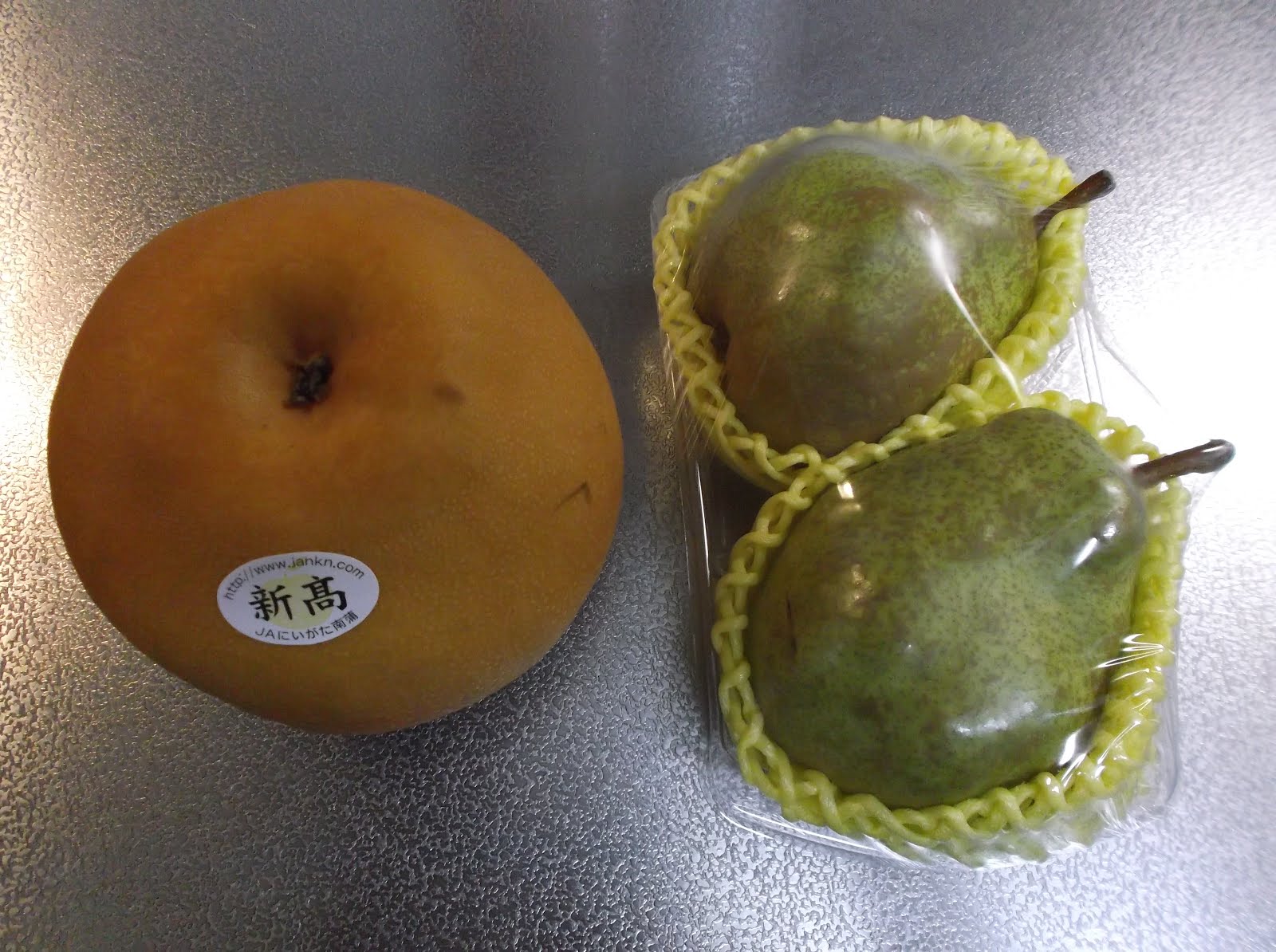
This variety of pear, called Claude Blanchet in France after the person who found it in 1864, is called La France in Japan. La France is a popular variety, together with Le Lectier, which also originates in France.
フランスでは、1864年に発見した人にちなんでClaude Blanchetと呼ばれるこの洋梨は、日本ではラフランスと呼ばれています。ラフランスは、ルレクチエ(こちらも原産はフランス)とともに、日本では人気のある洋梨の品種です。 

Compare this variety with a Japanese variety of pear, Niitaka.
この品種を日本の梨の品種、新高と比べて見て下さい。

November 10, 2012

Kakinomoto (Omoinohoka)/かきのもと(おもいのほか)

Niigata is one of the few prefectures in Japan where people eat edible chrysanthemum flowers.  These flowers are called Kakinomoto (lit. "Under persimmons") in the Kaetu region (which includes Niigata city) of Niigata and Omoinohoka (lit. "Contrary to expectations") in the Chuuetsu region (which includes my city, Minami Uonuma).  Another name is Mottenohoka (lit. Outrageous), meaning that it is outrageous to have the Imperial crest (chrysanthemum).

Today, I bought 300 g Kakinomoto for 298 yen.
新潟県は、日本では数少ない、食用菊を食べる県の一つです。このような花は下越地方(新潟市を含む)では「かきのもと」、中越地方(私の住む「南魚沼市」を含む)では「おもいのほか」と呼ばれています。また、「もってのほか」という名称もあります。皇室の紋章を食べるとは、もってのほか、という意味です。

今日は、かきのもと300 gを298円で買いました。 
It's rather time-consuming separating each and every flower into petals.
花を一つ一つ花弁に分けるのは時間がかかります。
I regretted that I had bought Kakinomoto today...  Anyway, I had to complete the job.
今日、かきのもとを買って、後悔しました...。とにかく、終わらせないと。
Boil water and add some vinegar.  Add all the petals.  Each petal is hollow, which gives it a unique texture, so it floats on the water, and you have to use a pair of chopsticks to cook all petals thoroughly.  One recipe says to boil 150 g Kakinomoto for 20-30 seconds, but I had to boil them for more than 1 minute because of the volume (300 g).
お湯を沸かして、お酢を少し入れます。花を全部入れます。花弁は中空で(それが独特な食感を生む)、水に浮くので、箸を使って、ちゃんと茹でる必要があります。或るレシピーでは、150 gのかきのもとを20~30秒茹でると書いてありますが、量が多いので(300 g)、1分以上茹でました。 
Drain, and cool in cold water.  Some recipes say to drain and cool with a fan.
水を切り、冷水で冷やします。水を切ってから団扇(うちわ)で冷ますというレシピーもあります。 
The sauce is a mixture of:
1 cup (200 ml) dashi
6 tbsp (90 ml) say sauce
6 tbsp (90 ml) mirin.
ソースは、
出汁を1カップ(200 ml)
しょう油を大さじ6(90 ml)
みりんを大さじ6(90 ml)
混ぜたものです。


November 9, 2012

Akebia Rinds Stuffed with Meat/アケビの肉詰め

Yesterday, I bought a pack of three akebia fruits for 98 yen.
昨日、アケビを1パック(3個入り、98円)を買いました。

I decided to make akebi no niku zume (akebia rinds stuffed with meat) as part of supper tonight.  I learned only yesterday that akebia rinds are edible (but bitter).
今日の夕飯にアケビの肉詰めを作ることにしました。
昨日、アケビの皮は(苦いが)食べられると知りました。

I had to cut each akebia fruit carefully so as not to damage the "contents".
「中身」を傷つけないよう、慎重にアケビを切りました。
These are the sweet innards of akebia.  You put one in your mouth, have the sweet white substance, and spit out the black seeds.
これがアケビの甘い中身です。口に入れて、甘い白い部分を食べて、黒い種を吐き出します。
I dusted the inside of each akebia rind half with katakuriko (potato starch), and 
stuffed each with a mixture of:
300 g ground pork
1/2 naga negi, finely chopped
1/4 tsp salt
2 tbsp katakuriko 
半分に切ったアケビの皮の内側に片栗粉を振って、
豚の挽き肉 300 g
刻んだ長ねぎ1/2本
塩 小さじ1/4
片栗粉 大さじ2
を混ぜたものを詰めました。

I pan-fried them with a relatively large amount of oil.  One recipe says that you have to fry with a large amount of oil to remove the bitterness.
比較的多い油で焼きました。或るレシピーでは、苦さを抜くため、多めの油で炒めると書いてあったので。

Just as I had imagined, the purple color had gone...
想像した通り、紫色は消えてしまいました...。
The rest of the meat mixture was turned into small patties and baked in the toaster oven.
残りの肉は小さく分けて、オーブントースターで焼きました。
I also made potato salad.  We also had inada (young yellowtail) sashimi and aji no nanban zuke.  And, the leftover tonjiru (pork soup).  I added some enoki to the tonjiru.  We will have the niitaka nashi (pear) when my son comes home at around 8 o'clock.
ポテトサラダも作りました。いなだの刺身とアジの南蛮漬けも食べました。それから、残りの豚汁も。豚汁にはエノキを少し足しました。息子が8時頃帰ってきたら、新高梨を食べます。 
The akebia rinds were much less bitter than I had anticipated.
アケビの皮は思ったより苦くなかったです。
A

November 8, 2012

Tonjiru Season!/豚汁の季節!

It's been rather cold here in Niigata prefecture, so I made tonjiru as part of supper last night.  Instead of peeling satoimo (taro) with a knife, I used a sheet to aluminum foil to do this job.
新潟県では寒い日が続いたので、昨日の夕飯には豚汁を作りました。
里芋の皮を剥くのに、包丁を使わないで、アルミホイルで剥きました。

Just crumple a sheet of foil into a ball and rub the satoimo.
ホイルをくしゃくしゃに丸めて、里芋をこするだけです。
To surprise my son, I bought a pack of honey mushrooms (naratake in Japanese) at the supermarket.
息子を驚かすため、スーパーでナラタケを買いました。
As I said several times here in my blog, naratake is called amandare here in the Uonuma region of Niigata, and is highly valued.  My son and I have been unlucky with naratake, having been unable to find it for years. 
このブログで何回も言っているように、新潟の魚沼地域では、ナラタケをアマンダレと呼び、珍重されています。息子と私は、ナラタケに関しては運が悪く、ここ数年、採れてません。

Tonight, we had the leftover tonjiru.
今晩は、残りの豚汁を飲みました。 
As you may know, freshly made tonjiru is good, AND tonjiru left overnight is even better!
知っていると思いますが、作りたての豚汁は美味しいですが、一晩置いた豚汁はもっと美味しいです!